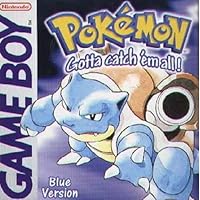


The Red and Blue versions may have seen stateside release in 1998, but the game was actually made in 1995. Before the television show came around. When the TV series took off in America, the games came next and as I said, they sold more copies than the latest installment of Harry Potter. I'm not kidding.
Red and Blue began almost everything you currently see in the series today. The game begins with you naming your character (you couldn't choose between a boy or a girl in this one) and then your rival. Again, if you had Pokemon fever you probably named your main character Ash and your rival was named Gary (even the strategy guides referred to them as such). It began with Professor Oak letting you have a Pokemon of your choice (between 3 starters) and then ultimately he'd send you on a journey with a Pokedex and have you document the Pokemon you'd find. Along the way, you'd have to deal with Team Rocket, the bad guys who are always causing trouble and stealing everyone's Pokemon, as well as gather eight badges so you could challenge the Elite Four and become a Pokemon League Champion. The entire formula began here, and just about everything mentioned above has been done in each and every main series Pokemon game hereafter.
What was perhaps the strangest thing about Pokemon is that the game was surprisingly deep in terms of combat. It was your traditional turn-based combat. Simple, yet it was so complex. For one, the game has a Rock/Paper/Scissors method to it. Every Pokemon has a type, and every type has its own strengths and weaknesses. For example, Water is strong up against fire but it is weak vs. Grass. Grass is weak vs. fire etc. etc. No Pokemon is invincible. They all have a weakness to some type. Though in these versions the psychics definitely have an unfair advantage as the type they're weak against (bug) is almost non-existent and there are hardly any bug type attacks.
In the battle menu you're given a list of commands. Fight, Item, PKMN, or Run. You can switch Pokemon you've caught in and out of battle on the fly, but it'll usually cost you a turn. It's the strategic portion of Pokemon that makes battling fun and addictive. As you go through the game you'll be challenged by trainers and you never know what they'll throw at you! It's completely unpredictable and some of them are tough. It's also interesting because with 150 different Pokemon, the amount of teams you can make are endless, and it really makes you think about what types you want in your roster. Because most of the Pokemon types are weak vs. more than just one type. It's also important that you give them a variety of moves, as the moves are also typed. On paper it doesn't seem like much, but when you actually play the game, you'll find a clog in your drain you didn't even know you had because you thought your team was perfect... but then that one Pokemon comes along and exposes your fatal flaw.
Pokemon was no short game. It was full of all sorts of side quests. From the Safari Zone, to catching the Legendary Birds, to the Unknown Dungeon. There was plenty to do, and even after the game was over there was STILL more to accomplish. Of course, your main accomplishment was getting them all. Pokemon could easily keep you busy for well over 60 hours. In 1998 this is an amazing feat seeing as how most RPGs of TODAY don't keep you busy that long. The main quest itself only took a measly 15 hours or so, but all the extra content kept you on your toes.
Even more, Pokemon was one of the few Gameboy Games that made excellent use of the link cable. Since Red and Blue versions had different Pokemon, some only appeared in certain versions. You couldn't for example, catch a Magmar in the Red version, but you could in Blue. How then, were Red players supposed to catch all 150? By trading. Until Pokemon came around, my link cable was collecting dust. Trading was usually a slow grueling process, though. Traded Pokemon also got an experience boost so they were easier to train.
Even more exciting than trading, however, was what really made Pokemon a blast to play: Battling. You and your friends could get together and battle one another! Test out your Pokemon teams against your friends. They were, more often not, far better to battle against than the games trainers. It's always interesting to see who your opponents heavy hitter is. With your friends it was always interesting. Imagine how embarrassed you were to say a certain Pokemon sucked only to discover that the trainer actually did a good job training?
As far as the game looks and sounds, it didn't really look all that great when it was released in 1998 (it was after all, a game made in 1995). On the original gameboy it was pretty grainy (but very clear on the Gameboy Pocket) and of course it was black or white (unless you played it on a Super Gameboy or Gameboy Color). For a Gameboy game, though, it actually wasn't too bad. It was annoying to watch a Pokemon simply flinch to attack, and some of the animations weren't all that great, but it was to be expected due to the Gameboy's limitations. The music, however, was fantastic. The tunes were catchy--particularly the trainer battles and gym leader battles. The only really annoying thing was the sound effects. They weren't all that great, and its a shame that Nintendo actually continues to use those exact same sound effects in Pokemon games today. Still, for what it's worth, this was the game you wanted on the Gameboy.
Pokemon is a classic. It'll always be a classic. No matter who you are, if you played Pokemon ten years ago, the craze was completely undeniable. If you got addicted like I did, chances are you're still playing today. Because in its core, the game was far deeper than you thought it was, and the series continues to use that same basic formula even today.
Click Here For Most Helpful Customer Reviews >>
My kids and I all love the Pokemon Gameboys (the three of us each have our own Gameboy). The blue Pokemon game is very similar to the red, with the Yellow having some slight differences.I like the way the Pokemon game challenges kids. I suggest also buying one of the books which shows the various routes and places. This allows kids to work at the tasks without getting frustrated.
The idea is to start at Prof. Oak's house, get your first Pokemon from him, and then journey all around the land of Pokemon, collecting various wild pokemon (which you catch by battling them until they faint), and doing battle with other trainers along the way.
In the process, kids learn to manuever through mazes of increasing complexity (which is why the manuals are a help), to gather and use items, and to develop strategies for fighting various types of Pokemon. My five year-old even started to read while using her Gameboy, from needing to know which items she had with her (in her Item List)!
All in all these are great games which can be played over and over (although only one game at a time can be saved), and which will provide your kids with hundreds of hours of fun.


No comments:
Post a Comment